Why Psychology Health Group Transitioned to ProsperityEHR
15 min read

Choosing an EHR platform is one of the most consequential decisions a behavioral health practice makes. But what happens when your current vendor announces they’re making significant updates to the platform that will change how your staff work?
That’s exactly what Psychology Health Group (PHG) faced with us. We’d partnered for years, building trust and understanding their unique workflows. Then we announced our rebrand to ProsperityEHR and our plans to reengineer our clinical tools, documentation capabilities, and patient portal—building on our proven revenue cycle management foundation that practices already trusted. PHG had a choice: transition with us to the enhanced system, or use this moment as an opportunity to explore other vendors in the market.
For a multi-disciplinary practice like PHG—with psychologists, social workers, marriage and family therapists, and mental health counselors serving the Quad Cities community—this decision was high stakes. Their EHR touches every aspect of operations: clinical documentation, revenue cycle management, scheduling, patient communication, and compliance tracking. And we understood they needed to be certain about their path forward.
EHR Transitions Create Strategic Opportunities for Behavioral Health Practices
Whether by choice or circumstance, EHR transitions force practices to confront questions they might otherwise postpone. These inflection points create valuable space for honest evaluation:
- Is our current system enabling growth or creating barriers? Many practices work around limitations for so long they forget what’s actually possible.
- Are we spending too much on administrative overhead? The hidden costs of inefficient systems compound over time—in both dollars and clinician burnout.
- Does our technology actually understand behavioral health workflows? Generic medical EHR systems retrofitted for therapy create daily friction that many practices simply accept as normal.
- Can we see what’s happening in our revenue cycle? When claims and/or denials disappear into black boxes, practices lose both money and strategic visibility.
- What does our team genuinely need to reduce burnout and focus on patient care? Technology should support clinical work, not create additional administrative burden.
PHG used this transition moment to get crystal clear on their priorities—not loose goals or abstract ideals, but specific operational needs that would determine their practice’s trajectory.
The Power of Partnership in Behavioral Health Technology
“We’ve worked with this team for years, and they understand the unique challenges of running a group practice,” says Elizabeth Lonning, PsyD, MSCP, of Psychology Health Group. “When they told us about ProsperityEHR, we saw this as the evolution we’d been waiting for—not just in the software, but in how we serve our patients and support our providers.”
Trust matters a lot in these decisions. We already understood PHG’s workflows, their pain points with insurance billing, and their growth vision. They didn’t need to explain from scratch why group therapy documentation differs from individual sessions, or why behavioral health practices face unique credentialing challenges. We’d been solving these problems together for years.
More importantly, we shared fundamental values. Mental health professionals should spend their time helping people heal, not fighting their technology. Practice operations should run smoothly behind the scenes so clinicians can focus on what they do best. And patients deserve seamless experiences from their first appointment through final payment.
This alignment is what ultimately led PHG to continue their partnership with us through the platform updates. But even with established trust, they approached the decision methodically.
How PHG Evaluated Their EHR Requirements
PHG identified four critical priorities that their next EHR solution needed to address for their practice to thrive:
- Reducing Administrative Burden on Mental Health Clinicians
Therapists didn’t pursue graduate training to become experts in insurance claims or billing codes. They trained to provide quality mental health care. And still, many behavioral health clinicians spend hours each week on administrative tasks that pull them away from patient care and contribute directly to burnout—an industry-wide crisis that’s really getting worse.PHG needed technology designed to handle operational complexity behind the scenes. This meant intuitive clinical documentation that doesn’t require excessive clicking, automated workflows that eliminate manual data entry, and systems intelligent enough to catch potential issues before they become problems. They wanted their clinicians to be able to spend their time on care delivery, not be bogged down by paperwork.
With ProsperityEHR, we’ve designed documentation templates specifically for behavioral health contexts (because individual therapy, couples counseling, family sessions, medication management, and group therapy all have distinct requirements that medical EHR templates simply can’t accommodate). Treatment planning workflows follow clinical best practices rather than forcing providers to adapt their approach to rigid software limitations.
- Accelerating Revenue Cycles for Sustainable Practice Growth
Cash flow constraints are among the most common barriers to practice expansion. When weeks or months pass between delivering services and receiving payment, it becomes difficult to hire additional providers, open new locations, or invest in practice improvements. Unclear claims status and preventable denials compound these challenges, creating financial strain that affects every strategic decision.PHG needed real-time visibility into their revenue cycle. Where is each claim in the process? Which ones are at risk of denial? What patterns emerge in their reimbursement data? Without clear answers to these questions, practices operate partially blind to their financial health.
This is where our embedded insurance clearinghouse has made a significant difference for practices for years (and it remains the same proven system under our new brand). Unlike EHR systems that require separate integrations with third-party clearinghouses, we’ve built claims processing directly into our platform. Claims flow automatically from clinical documentation through the clearinghouse without manual intervention. Real-time, in-system eligibility verification happens before appointments, catching potential coverage issues before services are delivered. And our denial management workflows help practices quickly identify and resolve problems that do occur.Our revenue cycle management capabilities aren’t new, but they are battle-tested systems mental and behavioral health practices have relied on consistently for years. The result is faster payment cycles, fewer preventable denials, and the financial clarity needed to make confident growth decisions. PHG knew that they could count on this foundation to remain solid while we were making enhancements to other parts of the platform.
- Eliminating Compliance Risk with Behavioral Health-Specific Documentation
Behavioral health documentation requirements differ substantially from general medical records. Yet many practices use EHR systems built primarily for medical settings, with mental health features added as an afterthought. These generic templates create compliance gaps that become audit risks.
PHG needed documentation tools purpose-built for behavioral health contexts, including:
- flexible progress notes for therapy and medication management sessions
- treatment plans that align with clinical standards and payer requirements
- the ability to flexibly remind providers when it’s time to review treatment plans—a significant compliance win that helps practices avoid audit risks
- group therapy documentation that elegantly captures both individual and collective dynamics
We’ve spent over 30 years partnering with behavioral health providers, and this expertise shows in our approach to clinical documentation. Rather than adapt templates from medical EHR systems, we designed ProsperityEHR’s templates from the ground up, specifically for mental and behavioral health practices. Our robust treatment planning supports evidence-based approaches, goal tracking to ensure alignment and measurable outcomes, and automated review scheduling that keeps treatment plans updated and relevant. This means the documentation meets both clinical best practices and compliance requirements without forcing providers to work around system limitations.
- Creating Seamless Patient Experiences in Mental Health Care
Every interaction shapes the therapeutic relationship. From the first phone call seeking care through the final payment, patient experience either builds trust or creates friction. What’s frustrating for both providers and patients is that many practices still operate with fragmented systems that don’t communicate between scheduling, reminders, billing, and patient communication.PHG wanted integrated patient engagement tools that make accessing mental health care easier at every touchpoint:
- online scheduling so patients can book appointments when it’s convenient for them
- automated reminders via SMS and email to reduce no-shows
- secure chat for non-urgent questions between sessions
- clear, transparent, e-delivered billing statements and payment options that don’t create confusion or anxiety
Our patient engagement tools are built directly into ProsperityEHR, creating continuity throughout the care journey. When scheduling, documentation, billing, and communication all happen in one integrated platform, it creates a better experience for everyone involved, and ultimately better care delivery.
Why “Purpose-Built for Behavioral Health” Actually Matters
This phrase appears frequently in EHR marketing, but the distinction matters more than many practices realize. Most EHR platforms originated in medical offices and later added behavioral health features. It may not be “Frankensteined” per se, but this approach does create limitations that practices encounter daily because using medical software as your tech foundation misses the nuances of your actual workflows.
We took a different path when building ProsperityEHR. Our team understands that group therapy documentation differs from individual sessions, and that treatment planning workflows need to align with clinical models, not billing categories. We also know that behavioral health credentialing involves different requirements than medical provider enrollment, and that therapy practices often operate across multiple locations with varying service types.
That’s why we very intentionally developed specialty-focused features like our comprehensive task management system. This allows mental and behavioral health providers to automate tasks and assignments, create actionable tasks for quick follow-up, and access intuitive views including sorting and filtering. These tools help keep a provider’s focus where it belongs – on the patient – and also ensure that nothing falls through the cracks.
How Integration Within One Platform Offers an Advantage
PHG was especially interested in ProsperityEHR’s ability to eliminate technology fragmentation. Many behavioral health practices operate with five or more separate systems—one for scheduling, another for clinical documentation, a third for billing, a fourth for patient communication, and possibly others for compliance tracking or telehealth.
This fragmentation creates constant friction. Data doesn’t flow automatically between systems, requiring manual entry or reconciliation. Staff need to log into multiple platforms throughout the day. Problems fall through the gaps between systems. And practices pay multiple subscription fees for tools that should work together seamlessly.
With our integrated approach, everything happens in one platform:
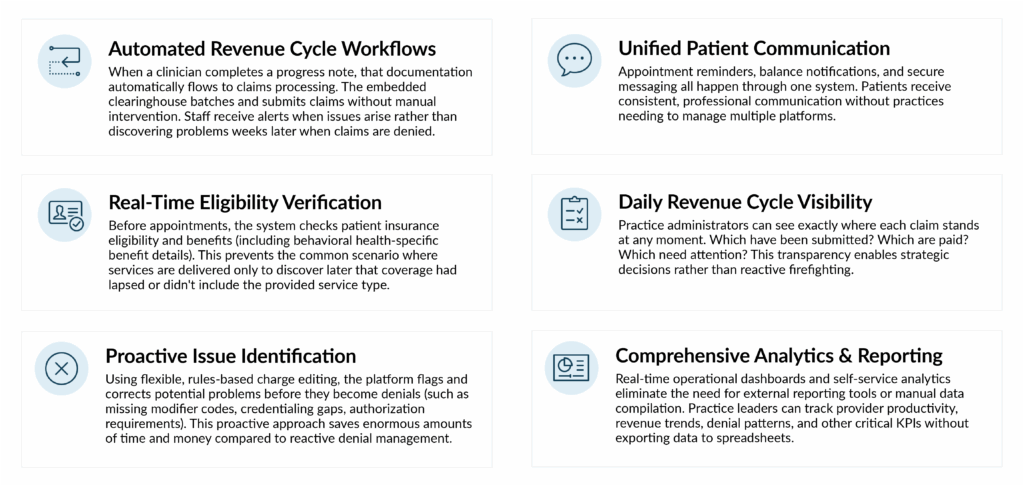
For practices that want even less administrative burden, we also offer managed billing services where our team handles revenue cycle management end-to-end, and consulting services for practices that want expertise without full outsourcing.
Strategic Questions for Evaluating Your Behavioral Health EHR
Whether you're considering a platform transition or simply wondering if you've outgrown your current EHR, these questions can guide your evaluation:
Does your EHR enable or constrain your growth strategy?
Consider whether your current system can scale with your plans. Can it handle multiple locations and EINs? New service types like IOP, TMS, or group therapy? Or are you avoiding expansion partly because your technology can't support it?
What's the total cost of your technology ecosystem?
Count all the separate subscriptions: scheduling systems, patient communication platforms, billing services, clearinghouse fees, compliance tools, telehealth, and whatever else you've added to compensate for gaps. Integration often reduces total costs while improving functionality. Calculate your total cost of ownership
What does administrative burden actually cost your practice?
Calculate the hours your clinicians spend on documentation, billing inquiries, and operational tasks versus direct patient care. Factor in the impact on provider satisfaction, retention, and your ability to recruit quality clinicians in a competitive market.
Does your EHR truly understand behavioral health workflows?
Evaluate whether your templates and processes reflect how therapy practices actually operate. If you get feedback that your providers are constantly working around limitations or adapting mental health workflows to medical templates, you're probably losing efficiency and increasing compliance risk. You also increase the risk of provider burnout.
Can you measure what matters with robust analytics and reporting?
This is where many practices discover critical gaps in their current systems. Do you have access to daily, weekly, and monthly operational reports? Can you track the KPIs that actually drive practice growth—provider productivity, revenue trends, operational efficiency? Can you identify patterns in your data and make informed, strategic decisions based on real-time insights?
We've built comprehensive analytics and reporting capabilities into ProsperityEHR because we know that data-driven decision-making separates thriving practices from those that struggle. Our operational and outcomes metric dashboards, self-service embedded analytics, and flexible reporting tools help you understand trends, measure performance, and identify opportunities for improvement. All data within ProsperityEHR is structured to integrate seamlessly into our analytics dashboard, giving you customizable views of the data trends that matter most to your practice.
We've built comprehensive analytics and reporting capabilities into ProsperityEHR because we know that data-driven decision-making separates thriving practices from those that struggle. Our operational and outcomes metric dashboards, self-service embedded analytics, and flexible reporting tools help you understand trends, measure performance, and identify opportunities for improvement. All data within ProsperityEHR is structured to integrate seamlessly into our analytics dashboard, giving you customizable views of the data trends that matter most to your practice.
Can you answer these revenue cycle questions immediately?
Where is any claim right now in the process? What percentage of our claims are denied on first submission? What are our most common denial reasons? What's our average time from service delivery to payment? If these questions are difficult to answer, you're likely leaving money on the table and operating without crucial financial visibility.
What happens when you encounter problems?
Consider not just the features but the partnership. Does your vendor understand the specific challenges behavioral health practices face? Can you have honest conversations about pain points? Do they proactively solve issues or wait for you to discover problems?
What PHG Anticipates from Their Transition to ProsperityEHR
PHG is currently in the onboarding process with us, and here's what they're looking forward to:
| For Their Clinical Team | For Their Administrative Staff | For Their Patients | For the Practice |
| Significantly less time spent on documentation and administrative tasks
Workflows that align with how therapy actually happens rather than forcing adaptation to system limitations More energy and time for patient care instead of fighting technology |
Clear, real-time visibility into the revenue cycle
Fewer preventable denials due to eligibility checks and proactive issue flagging Faster identification and resolution of billing issues when they do occur More efficient daily operations with integrated rather than fragmented systems |
Easier self-serve online scheduling that reduces phone tag and saves time
Reliable appointment reminders that decrease no-shows More transparent billing that reduces confusion and anxiety Overall smoother experience from initial contact through treatment completion |
Stronger operational foundation to support growth plans
Improved cash flow enabling hiring and expansion Reduced compliance risk with purpose-built behavioral health documentation Technology infrastructure that scales with their long-term vision and supports operational excellence |
Building the Practice of Tomorrow, Not Just Surviving Today
PHG’s decision to continue their partnership with us through this platform transition represents a strategic investment in their future. They’re not just solving today’s operational pain points; they’re building infrastructure that will support the practice they envision in the coming years.
We recognize that these decisions carry both opportunity and uncertainty. Whether you’re considering staying with your current vendor, switching to a new platform, or simply evaluating whether your current systems adequately support your goals, PHG’s methodical approach offers a valuable framework.
The crucial question isn’t whether your current systems work today. It’s whether they’ll support where you’re headed. Think about additional providers you want to hire and retain, the new services you want to offer, the patient experience you want to create, and the sustainable practice you’re building for the long term.
We’re seeing these same patterns repeatedly as we continue to onboard mental and behavioral health practices across the U.S. This kind of transition, and the change management that comes along with it, presents real challenges for many practices. But those that approach these decisions strategically—with clear priorities, honest assessment of their needs, and focus on long-term vision rather than short-term convenience—position themselves for sustainable growth.
Take the Next Steps on the Path to Prosperity
If you're in a similar position to PHG, wondering whether your current EHR can support your growth plans, or considering whether a platform transition makes strategic sense for your practice, we'd love to chat.
We built ProsperityEHR specifically for behavioral health practices that want to achieve operational excellence:
-
- Reduce administrative burden so clinicians can focus on patient care
-
- Accelerate revenue cycles and improve cash flow for sustainable growth
-
- Eliminate compliance risk with purpose-built behavioral health documentation
-
- Create seamless patient experiences throughout the care journey