How behavioral health practices verify insurance eligibility at scale
10 min read
The short answer: Practices that verify eligibility well at scale don't depend on someone checking at the front desk. They run checks automatically against upcoming appointments, ask payers about behavioral health benefits instead of general medical ones, show the result where schedulers already work, and turn every failed check into a task with an owner before the client arrives.
Picture a Monday in January. The eligibility check came back active when the appointment was booked in December, so the session goes ahead. Then the claim goes out, and it turns out the client switched plans on January 1: new member ID, new deductible, different payer. Medical group leaders described this same sequence as a front-end leak in MGMA's January 2026 poll (MGMA, 2026d).
Coverage changes more often than it used to. Open enrollment for 2027 marketplace plans opened November 1, and with at least a dozen insurers leaving marketplaces in some or all of their states, many clients will start January on a new plan, with a new member ID and possibly a different network (Emerson, 2026). Deductibles reset on January 1, marketplace enrollees moved toward higher-deductible plans this year, and starting in 2027 many Medicaid expansion adults will renew every six months instead of every 12. A practice that checks eligibility once at intake is working from a snapshot that goes stale between sessions.
Why eligibility work keeps growing
It's already the heaviest phone work in many practices. In a March 2026 MGMA Stat poll, 45% of medical practice leaders named eligibility and prior authorization as their most time-consuming phone work, ahead of scheduling at 31% (MGMA, 2026a).
Clients are also carrying more of the cost. The average deductible on 2026 ACA Marketplace plans rose 37% to $3,786, and bronze plans grew from 30% to 40% of sign-ups (McGough et al., 2026). A deductible is the hardest dollar to collect: the median single-specialty practice collected 62% of copays at the time of service, but only 10.5% of other patient-due balances (MGMA, 2026b).
Medicaid adds a second wave. Starting January 1, 2027, states must redetermine eligibility every six months for adults covered through Medicaid expansion (National Council for Mental Wellbeing, 2026). Every renewal is another chance for coverage to lapse between sessions.
How do behavioral health practices handle insurance eligibility verification at scale?
The practices that keep up have stopped treating eligibility as a front desk task and started treating it as a system. Six habits show up again and again.
- Check on a schedule, not at check-in
Run checks automatically against upcoming appointments, and run them twice: once several days out, and again the evening before or the morning of the visit to catch appointments booked after the first pass. A check at the window leaves no time to fix anything: the client is in the waiting room and the hour is already committed. MGMA's advice to practices dealing with cost-driven no-shows points the same way: verify coverage several days before the visit, give an estimate when you can, and tell the client who to call about payment (MGMA, 2026c). MGMA calls the goal "financial clearance": eligibility, coverage details, estimated client responsibility, and authorization status settled before the date of service (MGMA, 2026d). Successful practices also conduct a chart audit on new intakes as well, ensuring that all of the patient’s paperwork is complete (financial consent, consent to treat, office policies, etc.) at least 24 hours prior to the appointment. This ensures patient’s have consented to your no-show or late-cancellation policies, and policies enabling you to collect their expected co-pay or cash towards deductible at time of service. A strong financial policy includes all of these variables and also enforces a card on file policy in order to automatically run these balances due.
- Ask for behavioral health benefits, not general medical
A general benefits request often comes back full of detail for office visits, urgent care and pharmacy, and thin or blank for psychotherapy. Requests that carry behavioral health service type codes ask the payer about the care you actually deliver. Also check whether the plan carves outpatient mental health out to a separate behavioral health plan. If it does, the medical plan's answer won't tell you what you need. For practices that offer interventional psychiatry, this process can differ. Many plans will have interventional psychiatry on the medical plan, where general medication management and psychotherapy services may fall on the carve out mental/behavioral health plan.
- Put the result where schedulers already work
If staff have to open a payer portal or a separate tool to see whether a check passed, it won't happen every time. The verified status and the date of the last check belong on the screens your team already uses at booking and check-in.
- Turn every failed check into a task with an owner
Finding a coverage problem is the easy part. What saves the claim is a person calling the client before the appointment. A failed or stale check should land on a worklist with a name attached, not in a report someone may or may not open. Front desk roles turn over, and the process shouldn't live in one person's head. Failures could be a result of dropped coverage, coordination of benefits issues, or carve out plans that require a call to the patient or a manual VOB.
- Re-verify Medicaid clients more often
Once six-month renewals start, a client who misses one renewal notice can lose coverage between sessions. In Pennsylvania, current recipients move to six-month renewals after their next renewal in or after February 2027, and someone whose coverage starts in January 2027 renews in July (Pennsylvania Department of Human Services, 2026). Retroactive coverage for expansion adults also shrinks to one month, so a lapse found late may not be recoverable.
Pennsylvania's Community Care Behavioral Health asks its providers to verify eligibility at every service visit or contact, and to confirm the client's address, phone and email at each appointment so renewal notices arrive (Community Care Behavioral Health Organization, 2026). One caution: a standard eligibility response shows whether coverage is active, not when the renewal is due. Checking on a schedule is how you catch a lapse early, and Medicaid clients need a shorter cycle than a commercial plan that rarely changes. A result that counts as current for a whole month can hide a lapse for weeks. If a client does lose coverage, point them to the state Medicaid agency, since they can reapply at any time.
- Tell clients what they'll owe before the first session
Eligibility tells you whether coverage is active and what the plan pays. Turning that into a number the client hears at intake is a separate step, and it's the one that keeps a deductible from becoming a surprise balance or a cancellation. For uninsured clients, and for insured clients who choose not to bill their plan, the No Surprises Act requires a written Good Faith Estimate (Centers for Medicare and Medicaid Services, 2021). Our self-pay vs. insured post covers both.
What to check for outpatient psychotherapy benefits
|
Check |
Why it matters |
|
Coverage is active on the date of service |
A plan that was active at intake may have ended at the last renewal or premium due date. |
|
Whether behavioral health is carved out |
If a separate behavioral health plan manages the benefit, verify with that plan. |
|
Network status for the rendering clinician |
Some plans treat associate-licensed clinicians under supervision differently. Confirm the plan covers the clinician's license type. |
|
Deductible and how much remains |
In January, most clients start over. A $3,000 deductible can mean several full-price sessions. |
|
Coinsurance or copay for outpatient mental health |
This is the number the client will feel at every visit. |
|
Visit limits |
An annual session cap is easier to plan around in January than to discover in October. |
|
Prior authorization requirements |
Some plans require authorization for certain services or after a set number of sessions. |
How ProsperityEHR handles eligibility at scale
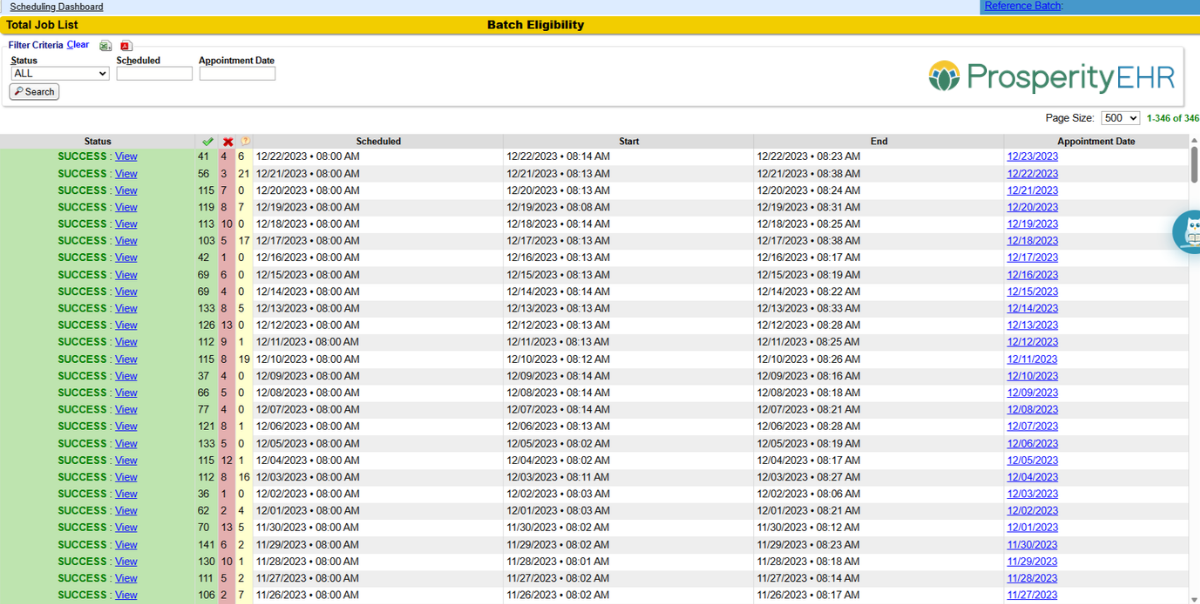
In ProsperityEHR, batch eligibility checks run against your appointment schedule. Our implementation team sets them up, and your staff can change them any time: how many days ahead to check, whether to run daily or on set weekdays, and which appointments to include, by clinician, appointment type, payer, or location. Most practices run two passes, one several days out and one the evening before. Staff can also run a check on demand.
You decide how long a result stays current, practice-wide or by payer. A client already verified this month isn't checked again, while Medicaid clients can be rechecked every week. A green check on the calendar shows which appointments have a current verification, and results also show on the client's dashboard.
Requests carry behavioral health service type codes, where the payer supports them. From the verification screen, staff can filter the response to outpatient mental health and see coinsurance, deductible and limits for that service, rather than a general medical benefit summary.
A batch results report flags every check that didn't go through, so the front desk sees exactly which clients to call.
Eligibility checks also go directly to state Medicaid programs in 48 states and the District of Columbia, on the same schedule, so a client whose coverage lapsed at a six-month renewal shows up before the session instead of at the window. A few states, including California, require a one-time enrollment before checks can run.
For practices that want the follow-through handled for them, our U.S.-based RCM team works eligibility, claims and denials as an extension of your staff.
See it run against your payers: book a demo.
References
Centers for Medicare and Medicaid Services. (2021, December 1). FAQs about Consolidated Appropriations Act, 2021 implementation: Good faith estimates (GFEs) for uninsured (or self-pay) individuals, part 1. https://www.cms.gov/CCIIO/Resources/Regulations-and-Guidance/Downloads/Guidance-Good-Faith-Estimates-FAQ.pdf
Community Care Behavioral Health Organization. (2026, August 26). Provider alert 20: Preparing for Pennsylvania HR1 changes: Supporting members in maintaining eligibility. [LINK]
McGough, M., Ortaliza, J., Lo, J., and Cox, C. (2026, May 19). What we know so far about 2026 ACA marketplace enrollment, premiums, and deductibles. KFF. https://www.kff.org/affordable-care-act/what-we-know-so-far-about-2026-aca-marketplace-enrollment-premiums-and-deductibles/
MGMA. (2026a, March). Phones are still a bottleneck costing medical practices time they cannot afford. MGMA Stat. [LINK]
MGMA. (2026b). 2026 MGMA Financials and Operations data report. MGMA DataDive.
MGMA. (2026c, August 12). About 1 in 3 medical groups see higher no-shows in 2026 as patients face higher costs. MGMA Stat. https://www.mgma.com/mgma-stat/about-1-in-3-medical-groups-see-higher-no-shows-in-2026-as-patients-face-higher-costs
MGMA. (2026d, January 7). Detecting and fixing leaks across the revenue cycle. MGMA Stat. https://www.mgma.com/mgma-stat/detecting-and-fixing-leaks-across-the-revenue-cycle
National Council for Mental Wellbeing. (2026). Key dates for H.R.1 implementation. https://hub.thenationalcouncil.org/wp-content/uploads/2026/04/H.R.1_Implementation_Timeline_v2-2.pdf
Pennsylvania Department of Human Services. (2026). Medicaid changes. https://www.pa.gov/agencies/dhs/resources/medicaid/medicaid-changes